

Your profit and loss statement can show a positive month while your bank account still feels uncomfortably tight. That disconnect is frustrating because it makes you question everything. Are sales strong enough? Are expenses too high? Are the reports wrong? Or is the business healthy on paper but exposed in real life?
For many growing businesses, the problem is not effort. You are selling, servicing clients, paying your team, and trying to stay ahead of the next decision. The problem is that profit and cash flow are not the same thing. If your financial system does not show both clearly, you can feel like you are guessing even when your reports look organized.
Why Profit And Cash Flow Tell Different Stories
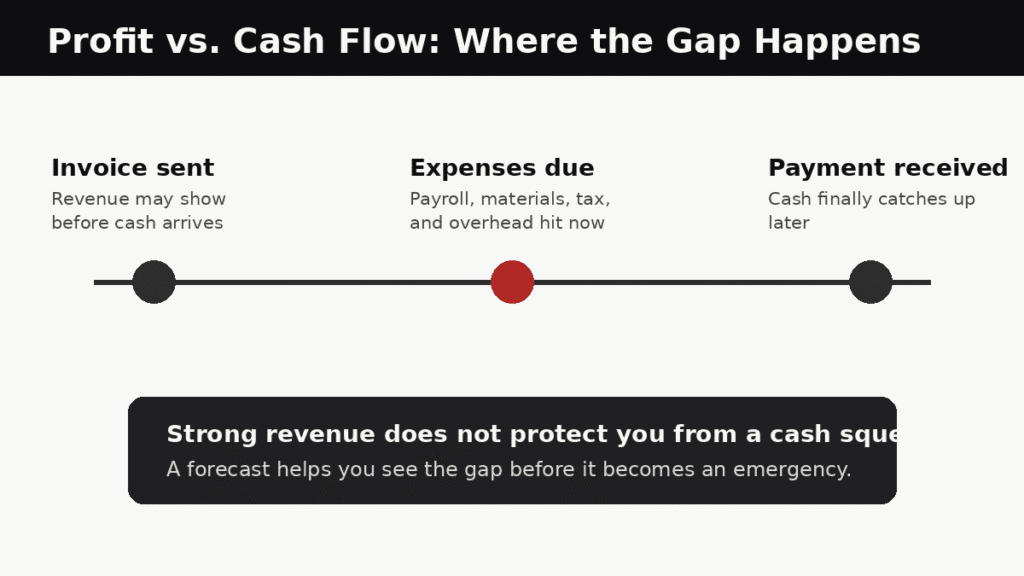
Profit measures whether revenue is greater than expenses over a period of time. Cash flow measures the actual movement of money in and out of the business. You can be profitable and still feel cash pressure when timing is off.
For example, you may invoice a client this week, record the revenue, and show profit on the P&L. But if that client pays in 30, 45, or 60 days, the cash is not available today. Meanwhile, payroll, software, rent, loan payments, subcontractors, taxes, and vendor bills may be due before the deposit arrives.
That timing gap is where stress builds. Strong revenue does not automatically protect you from a cash flow issue. You need a system that shows what is coming in, what is going out, and when it is expected to happen.
The First Place To Look: Your Books
Before you can fix a cash flow problem, you need to know whether your books are clean enough to trust. Small bookkeeping issues can create big decision-making problems. Misclassified transactions, missing entries, duplicate expenses, unreconciled accounts, or timing errors can make a report look complete while still hiding the real picture.
This matters because every financial decision sits on top of the books. If the foundation is weak, the reporting will be weak too. You may think a service is profitable when costs are missing. You may think cash flow is fine when receivables are aging. You may think you can afford a new hire or equipment purchase when tax obligations or payables are not fully visible.
Clean books are not just for tax season. They are the starting point for confident leadership.
The Second Place To Look: Your Cash Flow Rhythm
Once the books are accurate, the next question is timing. A business can feel stable one month and strained the next because cash inflows and outflows do not move evenly. This is especially common for project-based businesses, construction companies, firms with retainers, seasonal businesses, and companies carrying inventory.
A simple cash flow review should answer questions like:
- Which invoices are outstanding?
- When are they expected to be collected?
- What bills, payroll, tax payments, or debt payments are due soon?
- Are there seasonal slowdowns ahead?
- Is the business relying on one large payment to cover several obligations?
When those answers are unclear, owners tend to manage from the bank balance alone. That can work in survival mode, but it does not give you the forward-looking visibility needed to grow safely.
The Third Place To Look: True Profitability
Revenue can hide weak margins. A business may be busy, booked, and growing while still keeping less than expected after labor, materials, subcontractors, software, merchant fees, overhead, and taxes are accounted for.
This is where profitability visibility becomes critical. You need to know what is actually driving profit. That may mean looking by service line, product category, client type, project, job, or location. For construction companies, job costing is especially important because one profitable project can mask another job that quietly lost money.
The goal is not to obsess over every penny. The goal is to see which parts of the business deserve more attention, which need better pricing, and which may be draining cash without producing enough margin.
What Fixes The Disconnect
The fix is usually not another spreadsheet or more late-night bookkeeping. The fix is a clear financial structure. That structure starts with clean, accurate bookkeeping. Then it adds reliable reports, cash flow visibility, and a clearer understanding of profitability.
When those pieces are in place, the owner can stop reacting to surprises and start leading with better numbers. Instead of wondering whether the business can afford a move, you can look at the data. Instead of guessing whether sales are enough, you can see whether margins and cash timing support the next step. Instead of waiting until tax season to understand the year, you can make better decisions throughout the year.
Prime Accounting & Tax supports business owners with the accounting, CFO-level guidance, reporting, forecasting, and tax planning needed to build that financial foundation. The goal is simple: help you trust your numbers, understand your cash, and make decisions with more confidence.
Final Takeaway
If your business looks profitable but cash still feels tight, do not assume you are failing. The issue may be a fixable gap in your books, reporting, cash flow system, or margin visibility. Once you can see the gap clearly, you can build a plan to close it.
The next step is a Financial Clarity Session with Prime Accounting & Tax. We can review your current setup, identify what is off, and show you what needs to happen next so your numbers finally match the way your business actually feels.
Recent Comments